When you raise a glass of Assyrtiko in Santorini, you are drinking one of the oldest wine cultures on Earth. The story begins not in a modern winery, but buried beneath volcanic ash – in a Bronze Age city that predates ancient Greece by over a thousand years.
The City That Wine Built
Long before Santorini was called Santorini, the island carried two distinct names belonging to two very different eras. In its earliest days, it was known as Strongili – meaning “the circular one” in Greek, a reference to the island’s original round shape before the great volcanic eruption reshaped it forever. This was the island of the Bronze Age, the island of Akrotiri, the island of an ancient civilization that flourished for centuries before catastrophe struck.
Centuries later, around the 9th century BCE, a Spartan prince named Theras led a group of colonists to the island and gave it a new name: Thera. These are not interchangeable names for the same place. They mark two separate chapters – the pre-eruption Bronze Age world of Strongili, and the later Greek colonial world of Thera that slowly rebuilt on the same volcanic ground.
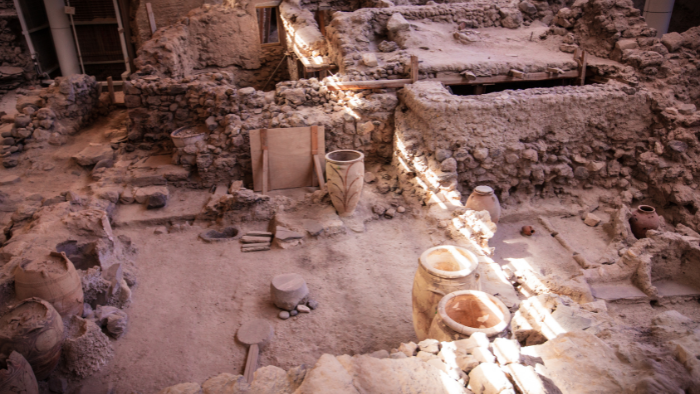
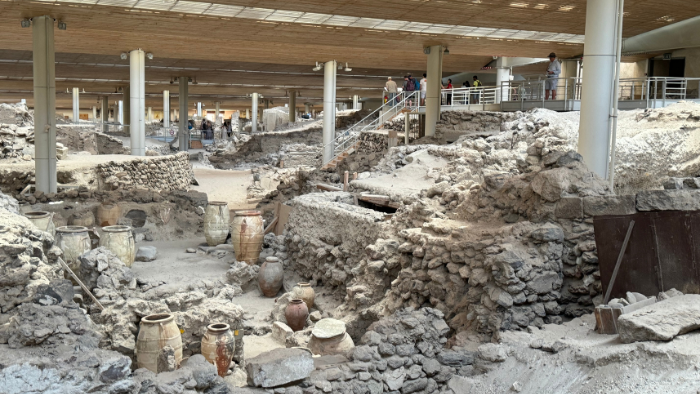
At the southern tip of this ancient island, a thriving Bronze Age city flourished for centuries. We now call it Akrotiri, and it is one of the most remarkable archaeological discoveries in the Mediterranean world.
Excavations begun by archaeologist Spyridon Marinatos in 1967 revealed a city of extraordinary sophistication: multi-storey buildings, intricate frescoes still vibrant with color, advanced drainage systems with both hot and cold running water, and – crucially for our story – evidence of winemaking dating back to 2,500 BC.
Among the finds were small ceramic jars with faucets, wine vessels, and grape seeds. The people of ancient Strongili were not just drinking wine – they were producing it, trading it, and celebrating it as part of daily life. This makes Santorini one of the oldest documented winemaking regions on the planet.
The Eruption That Changed Everything
Around 1,600 BCE, the volcano beneath Thera erupted with a force that reshaped the ancient world. The explosion – one of the largest in recorded human history – buried Akrotiri under metres of volcanic ash, preserving it much like Pompeii would be preserved centuries later, but over a thousand years earlier.
The eruption ended the Minoan civilization on Thera. It created the dramatic caldera that today defines Santorini’s iconic silhouette. And it left behind something unexpected: a geological gift that would eventually make Santorini’s wines unlike any other on Earth.
The ash, pumice, solidified lava, and volcanic tuff that buried the island formed a soil type locals call aspa – a porous, mineral-rich, almost nutrient-free growing medium that forces vines to work extraordinarily hard for survival.
For centuries after the eruption, the island was largely uninhabitable. It was only during the Geometric and Archaic periods (roughly 900-600 BCE) that Greek colonists began returning, slowly reviving agriculture and trade. And with them came winemaking – picking up a tradition that had been interrupted, not extinguished.
Why Volcanic Soil Makes Extraordinary Wine
The same catastrophe that destroyed ancient Thera is the reason Santorini wine tastes the way it does.
Aspa soil – dominated by pumice, volcanic tuff, ash, and basalt – is unlike any other vineyard soil in the world. It has almost no nutrients, very low water retention, and a pH averaging around 8.2. These conditions sound hostile. For grapevines, they are transformative.
Forced to dig their roots deep into the volcanic earth in search of moisture and minerals, Santorini’s vines develop extraordinary concentration. The grapes that emerge are low-yielding, intensely flavored, and carry a briny, saline minerality that researchers have measured at 700% higher sodium levels than Assyrtiko grown anywhere else in the world.
There is another remarkable consequence of this volcanic soil: phylloxera cannot survive in it. The devastating root louse that destroyed vineyards across Europe in the late 19th century never took hold in Santorini. As a result, the island’s vines remain ungrafted – growing on their own original rootstocks, some of them 150 to 200 years old. Local growers insist certain root systems may be over a thousand years old.
When you drink a glass of Santorini Assyrtiko, you may be tasting fruit from a vine that was already old when your grandparents were born.
The Kouloura: An Ancient Solution to an Ancient Problem
The volcanic soil is only part of what makes Santorini viticulture unique. The island’s fierce winds – the Meltemi, which can reach 100 km/h – forced farmers to develop one of the most distinctive vine-training systems in the world.
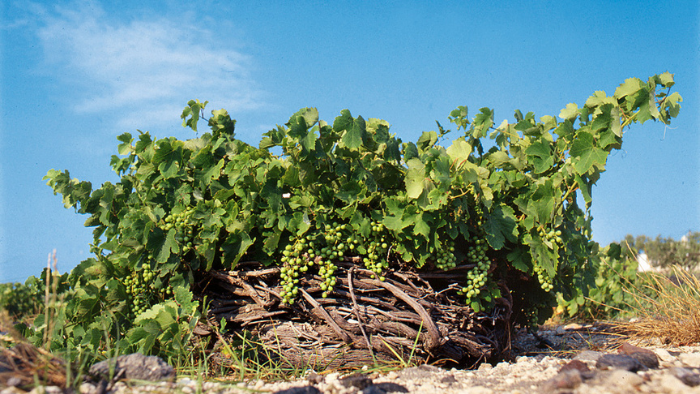
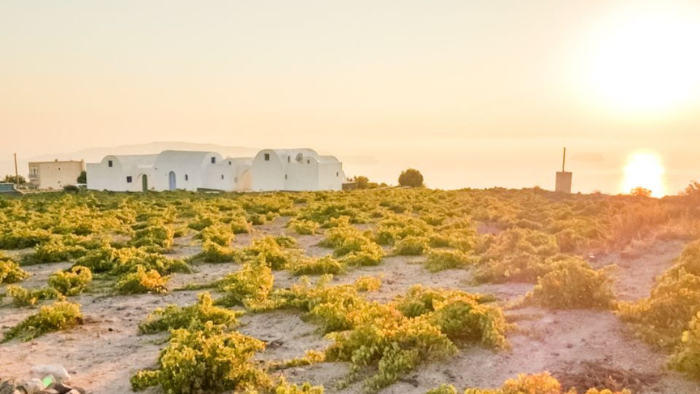
Called the kouloura (meaning “basket” in Greek), this method involves training vines low to the ground in a tight, circular coil. The shoots are woven into a protective nest that shields the developing grapes from the wind and the intense Aegean sun. It is extraordinarily labor-intensive – each vine must be tended by experienced hands – and it is among the most ancient agricultural techniques still practiced in the Mediterranean today.
The kouloura does more than protect the grapes. It creates a microclimate within the basket, retaining moisture from the island’s morning dew (the vines receive no irrigation – a practice known as anidro, or dry farming). This forces roots even deeper into the volcanic soil, drawing up more of those distinctive minerals.
Walk through a Santorini vineyard and you will see hundreds of these low, coiled baskets spread across the landscape. It looks unlike any vineyard you have ever seen. It has looked this way for centuries.
Assyrtiko: The Grape That Survived History
The indigenous grape variety at the heart of Santorini wine is Assyrtiko – a white grape uniquely adapted to the island’s volcanic conditions. Nowhere else in the world does Assyrtiko produce wines of the same character. The combination of volcanic aspa soil, dry-farmed ancient vines, kouloura training, and the island’s specific microclimate creates something that simply cannot be replicated.
Santorini Assyrtiko is defined by:
- Razor-sharp acidity – the grape retains remarkable freshness even at full ripeness, with wine pH often measuring close to 2.8
- Saline minerality – a briny, almost oceanic quality that comes directly from the volcanic soil and sea air
- Citrus and stone fruit – lemon zest, white peach, and green apple, with concentrated intensity from low-yielding old vines
- Exceptional aging potential – despite its freshness, Santorini Assyrtiko can age for a decade or more, developing complexity and texture
Beyond the dry white wine, Santorini produces two other styles worth knowing:
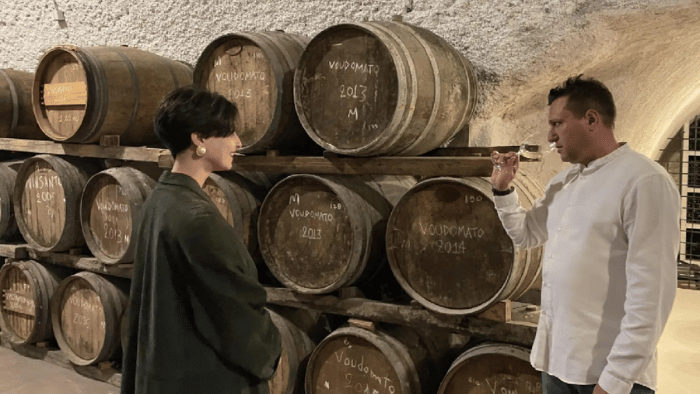
Nykteri – a more structured, barrel-aged expression of Assyrtiko with a minimum 13.5% alcohol. Traditionally made from late-harvest grapes, it carries more weight and spice while retaining the grape’s signature acidity.
Vinsanto – Santorini’s legendary sweet wine, made from sun-dried Assyrtiko grapes. The drying process concentrates sugars to extraordinary levels, and the wine is then aged oxidatively in oak barrels for a minimum of two years. Vinsanto has been produced on the island since at least the 12th century and was once traded across the Mediterranean for Russian oak barrels. A single sip carries centuries of history.
From Akrotiri to Your Glass: A 4,500-Year Line
The thread connecting ancient Akrotiri to a modern glass of Santorini wine is unbroken – even if it was stretched thin by a volcanic eruption.
The people of Bronze Age Thera discovered that this volcanic island could produce exceptional wine. They built a civilization around it. A catastrophe buried that civilization, but in doing so, it created the geological conditions that make Santorini’s wines extraordinary today.
The kouloura baskets you see in the vineyards are a direct inheritance from farmers who had no choice but to find a way to grow grapes in one of the most challenging environments on Earth. The ungrafted vines, some of them centuries old, are a living archive of that persistence. And the Assyrtiko grape itself – unchanged, unadulterated, still thriving in volcanic soil that kills most other plants – is the most direct connection you can have to the ancient world of Thera.
Visit Akrotiri and the Wineries Together
The most rewarding way to experience this story is to walk through both worlds in a single day. Akrotiri Archaeological Site – often called the “Pompeii of the Aegean” – is open to visitors and gives you a visceral sense of how sophisticated and wine-centered Bronze Age life on the island truly was. From there, visiting the island’s wineries takes on an entirely different meaning.
Santorini’s wineries sit on the same volcanic ground that buried Akrotiri – and the best ones know it. Tasting a dry Assyrtiko here, looking out over a caldera formed by the same eruption that created this terroir, is one of those rare moments where history and pleasure land in the same glass. If you want to combine Akrotiri with a private wine experience, contact Wineland and we will customize the day for you.
It is not just a wine tour – it is a journey through 4,500 years of human civilization and its relationship with this extraordinary island.
Because in Santorini, wine is not just a product. It is history you can taste.
Ready to Plan Your Visit?
Book a Private Santorini Tour with Wineland Tours
A private tour with a knowledgeable local guide is one of Santorini’s most memorable experiences. Explore our tours, and curated island journeys.
Frequently Asked Questions
What is the connection between Akrotiri and Santorini wine?
Akrotiri is a Bronze Age settlement buried by a volcanic eruption around 1600 BCE. Archaeological finds there show evidence of winemaking dating back to 2,500 BC, making it one of the oldest documented wine cultures in the world. The same eruption that destroyed the city also created the volcanic soil that gives Santorini wine its distinctive character today.
How old are the vineyards in Santorini?
Many of Santorini’s vineyards contain ungrafted vines that are 150 to 200 years old, with some root systems believed to be over a thousand years old. Because phylloxera cannot survive in the island’s volcanic soil, the vines have never needed to be replanted on new rootstocks, making them among the oldest in the world.
What makes Santorini wine different from other Greek wines?
Santorini wine is grown in volcanic aspa soil made of pumice, ash, and lava – a growing environment unlike anywhere else in Greece. The island’s Assyrtiko grape produces wines with razor-sharp acidity, intense saline minerality, and concentrated citrus flavors. Vines are dry-farmed and trained in the traditional kouloura basket method, adding further uniqueness to the wine’s character.
Can you visit Akrotiri and Santorini wineries on the same day?
Yes. Akrotiri Archaeological Site and Santorini’s main wine-producing villages are both located in the southern part of the island, making a combined visit very practical. Contact Wineland and we will put together a customized private itinerary that pairs the excavations with the island’s finest wineries.
What wines should I try in Santorini?
The three essential Santorini wines are Assyrtiko (a dry white with high acidity and saline minerality), Nykteri (a more structured, barrel-aged white with higher alcohol), and Vinsanto (a complex sweet wine made from sun-dried grapes, aged oxidatively in oak). All three are made primarily from the indigenous Assyrtiko grape.
Written by
Yiannis Kotzampasakis
Co-Founder & CEO · WSET Certified Sommelier · Wineland Tours
Yiannis was born in Athens and has called Santorini home for the past seven years. With a Bachelor’s degree in Tourism and over 20 years of experience across tourism and wine, he designs Wineland experiences with the confidence of someone who knows both the island and the glass. He guides guests through Santorini’s wines with clarity and warmth, making wine approachable for beginners while still exciting for seasoned enthusiasts.