Every Santorini cooking class listing promises the same three things: hands-on, authentic and unforgettable. Almost none of them tell you what you will actually cook, which wines land next to the food, or why any of it tastes the way it does on this particular island.
That gap matters, because Santorini grows ingredients that exist almost nowhere else, and the wine grown beside them was shaped by the same volcanic ground.
Quick answer: A Santorini cooking class is a hands-on session, usually 3 to 5 hours, where a local chef teaches you to cook traditional island dishes using Santorini’s own produce: fava, cherry tomatoes, white aubergine, capers, and local cheese. The best versions pour the wine alongside the food rather than after it, because the island’s high-acid volcanic wines were built to sit next to these dishes. Expect to cook 4 to 5 dishes, taste 4 or more wines, and sit down to eat what you made with a different wine beside each course. Prices start around €150 per person for group classes, and private classes with a winery tasting start from €200.
What Does a Santorini Cooking Class Actually Involve?
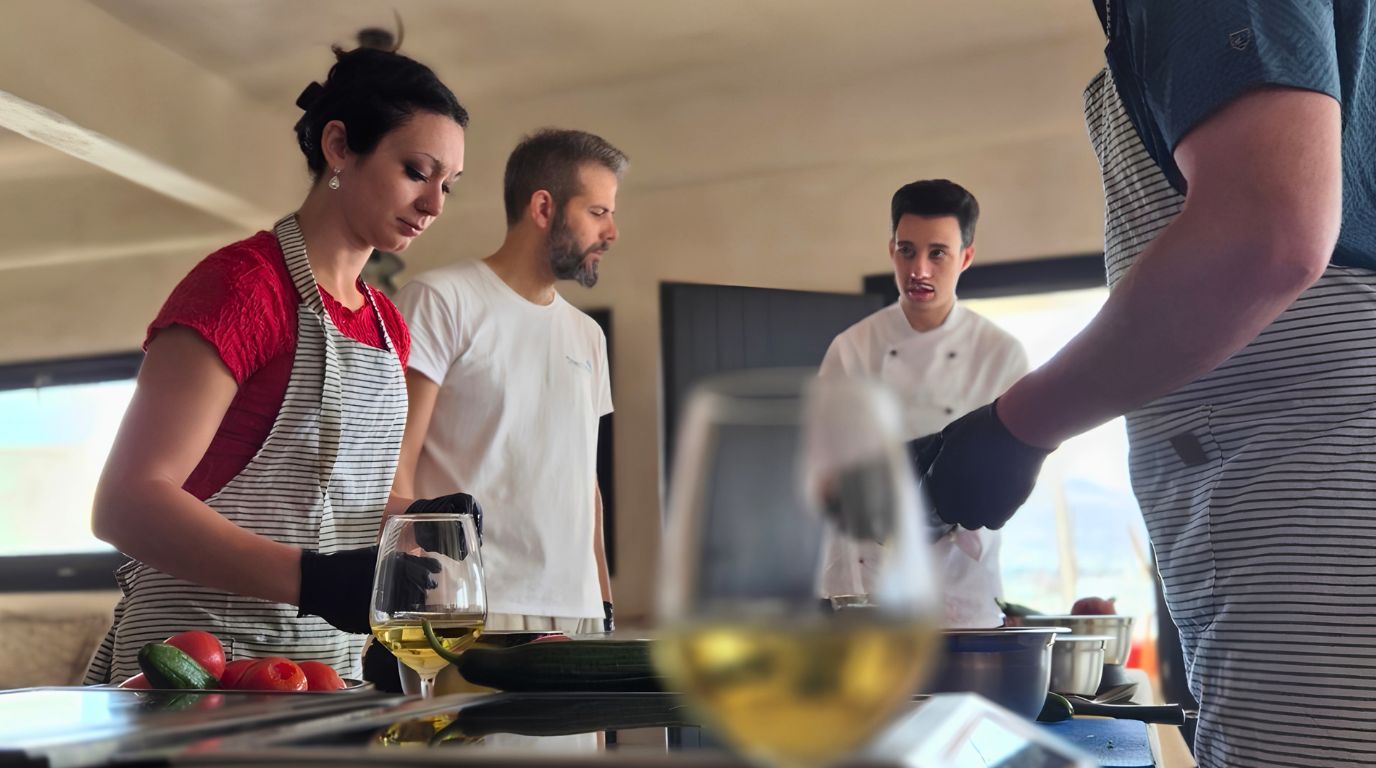
A Santorini cooking class runs 3 to 5 hours and splits into three parts: around an hour and three quarters of hands-on cooking with a chef, a sit-down meal of what you prepared, and wine running through both, poured while you cook and then matched course by course while you eat. The better versions add a guided tasting at a working winery afterwards. Group classes usually seat 6 to 15 people. Private classes seat only your party. No cooking experience is required in any format.
What separates a good class from a mediocre one is how much you actually touch. In weaker versions, the chef demonstrates and you watch, then eat. In stronger versions, you grate, fold, fry, and plate every dish yourself.
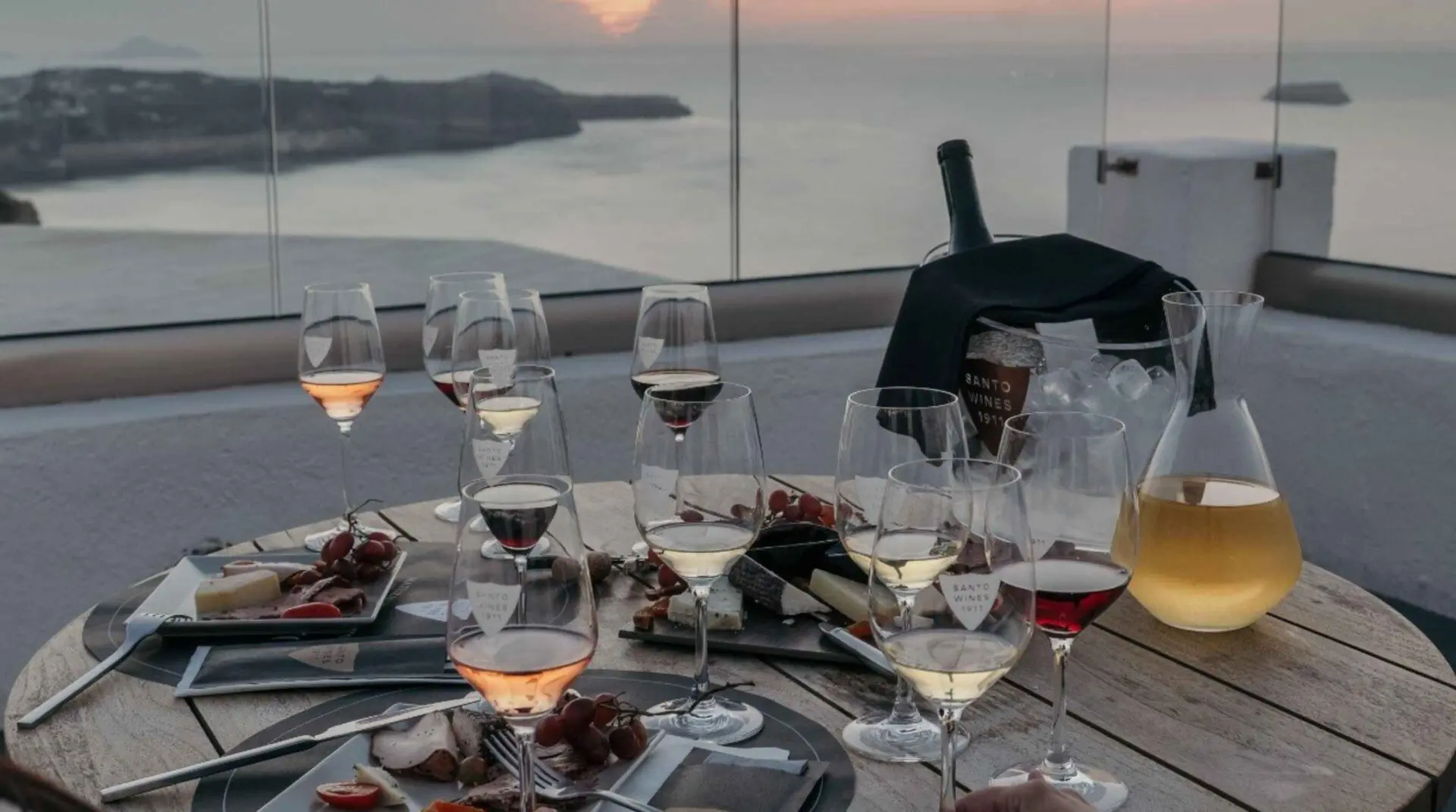
The second differentiator is whether the wine is an afterthought. Many classes pour a house white with the meal and call it a pairing. A smaller number put a different wine next to each course so you taste the pairing as it happens, then take you to a working winery where a sommelier explains why it works.
You should leave with four things:
- Four or five dishes you can rebuild at home with supermarket substitutes.
- A working understanding of Santorini produce and why it behaves differently in a pan.
- The pairing logic, not just the pairings.
- Context for the rest of your trip. Every menu you read afterwards makes more sense.
The Hands-On Version
5-Hour Private Cooking Class and Wine Tasting
A fully private class with a local chef, with wine poured while you cook and matched to each course at the table, followed by a guided tasting of four wines at a working winery with a certified sommelier. You cook tomato fritters, Santorini fava, a fresh island salad, pork tigania (chicken for anyone who does not eat pork), and ryzogalo, the Greek rice pudding with cinnamon. Hotel, port, or airport pickup is included, along with all ingredients, equipment, an English-speaking guide, taxes, and cable car tickets for cruise passengers. Vegetarian menus and allergy adjustments are arranged in advance. From €200, fully refundable up to 3 days before.
Which Ingredients Only Santorini Grows?
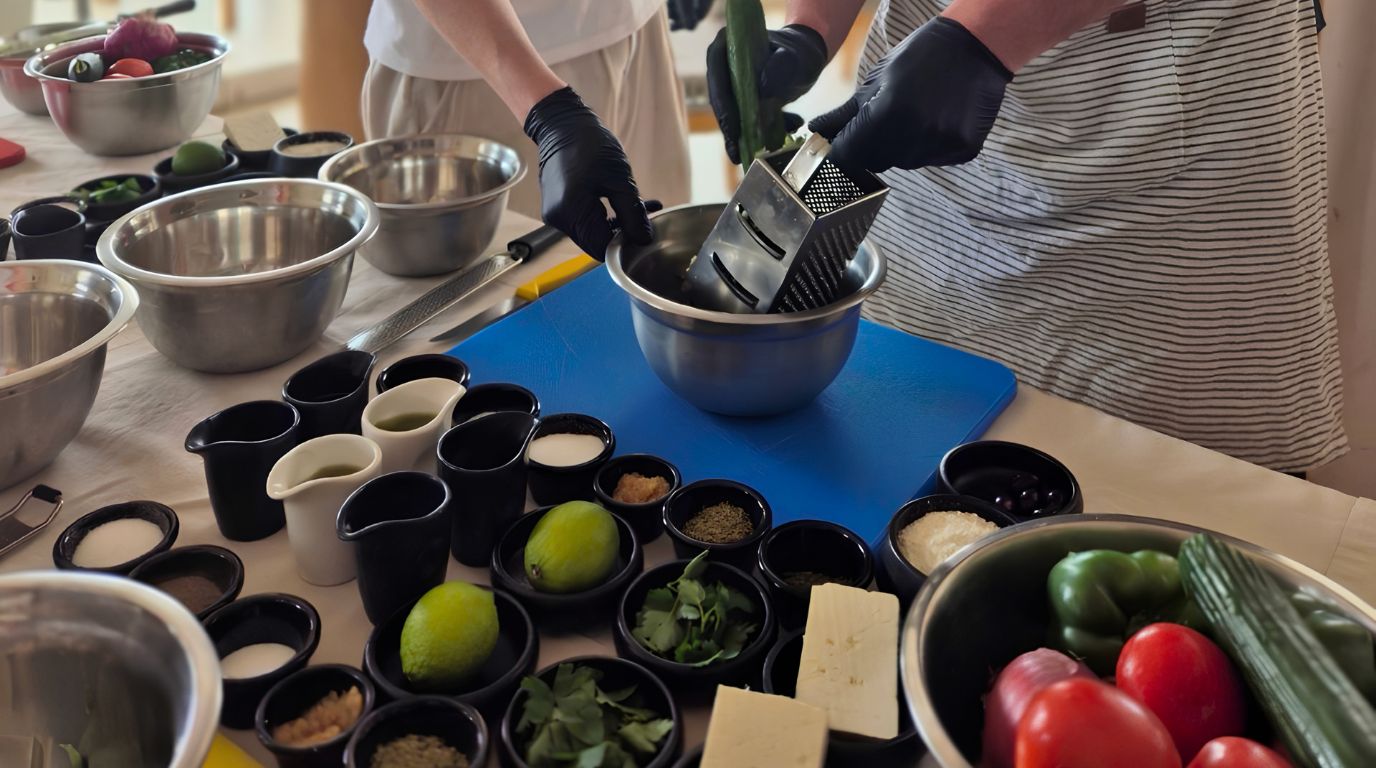
Santorini grows a small group of crops that are genuinely local, several with PDO status (Protected Designation of Origin). The island receives less than 370mm of rain a year, so plants survive on dew and an average humidity near 71%, pulled out of the air by porous volcanic soil. Low water means low yields and concentrated flavour. That single fact explains most of the island’s cooking.
This is the part almost every cooking class listing skips, and it is the reason the food tastes different here.
Drought does to vegetables what it does to vines. It shrinks them, thickens their skins, and concentrates their sugars and acids. A Santorini cherry tomato weighs only 15 to 27 grams and carries firm, dry flesh with a sweet, strongly acidic taste. It received PDO protection in 2013.
| Ingredient | What makes it different | What it becomes on the plate |
|---|---|---|
| Fava Santorinis PDO | Not a split pea. It is Lathyrus clymenum, a legume cultivated on the island for around 3,500 years | A silky yellow purée, served warm with olive oil, capers, and raw onion, and the bed the main course arrives on |
| Tomataki Santorinis PDO | 15 to 27g, thick-skinned, low moisture, high sugar and high acid | Tomato fritters that hold together with almost no flour, and slow-cooked sauces |
| White aubergine | Fewer seeds, sweeter, less bitter than purple varieties, no salting needed | Smooth melitzanosalata, and lighter, sweeter versions of any baked aubergine dish |
| Katsouni cucumber | Thicker skin, more seeds, cooler and sweeter than a standard cucumber | The backbone of a true Santorini salad, eaten raw |
| Capers and caper leaves | Wild, grown on cliff faces and terrace walls, brined rather than fresh | Salt and acidity in salads, and the finishing note on fava |
| Chlorotyri | Fresh, soft goat cheese, tangy and lightly salty | Eaten alone, folded into fritters, or paired with Vinsanto |
Notice a pattern in that right-hand column. Salt, acid, and concentration appear in nearly every dish. Hold onto that, because it is exactly what the wine has to answer.
What Do You Cook in a Santorini Cooking Class?
Most Santorini classes teach a fixed core of four to five dishes: tomato fritters (tomatokeftedes), Santorini fava, a fresh island salad, one substantial main, and a traditional dessert. The dishes are chosen because they are simple to rebuild at home and because each one demonstrates a different local ingredient.
On our class the current menu puts pork tigania in the main slot, with chicken cooked the same way for anyone who does not eat pork, served with the fava, and finishes with ryzogalo, rice pudding with cinnamon. Here is what you actually learn in each, beyond the recipe card.
Tomato fritters. The technique is about restraint. Santorini tomatoes carry so little water that the batter needs a fraction of the flour a mainland recipe calls for. Grate, drain briefly, bind with onion, mint, and just enough flour to hold, then fry hot and fast.
Fava. No blender. The legume breaks down on its own into a purée if you simmer it long enough and skim carefully. What you are learning is patience and seasoning at the end, not equipment.
Island salad. Assembly, not cooking. The lesson is proportion, and the discipline to leave things out. Katsouni, cherry tomatoes, capers, caper leaves, chlorotyri, olive oil. No lettuce, no dressing, no vinegar.
Pork tigania, or chicken. The substantial course. Tigania is pork cut small and seared fast in a hot pan, so the lesson is heat management and knowing when to stop, not a long bake. Chicken gets the same treatment for anyone who does not eat pork. It comes to the table with the fava underneath, which does the job a sauce would elsewhere.
Ryzogalo. Rice pudding, finished with cinnamon. Slow, gentle and dairy-based, and the reason the Vinsanto at the end of the tasting lands the way it does.
How Do You Pair Santorini Wine With Santorini Food?
Santorini’s wines and its food evolved on the same drought-stressed volcanic soil, so they fit together for a structural reason: the food is salty, acidic, and fat-rich, and the wine carries unusually high acidity and minerality to cut through it. Assyrtiko is the anchor. It keeps a sharp, saline edge even in a hot climate, which is rare in white wine and precisely why it works.
No other article on this topic explains the logic, so here it is properly.
Acidity in wine does the same job as a squeeze of lemon. It resets your palate between bites of anything fried, oily, or rich. Santorini cooking leans hard on olive oil and frying, so a low-acid wine collapses next to it. Salt does something else: it softens the perception of acidity and makes a sharp wine taste rounder. That is why capers and brine make Assyrtiko taste better, not worse.
| Course | Wine | Why it works |
|---|---|---|
| Tomato fritters | Assyrtiko | Fried food plus a high-acid, high-mineral white. The acidity cuts the oil; the tomato’s own acidity is matched rather than overwhelmed |
| Fava with capers and onion | Assyrtiko or Nykteri | Fava is dense and earthy. Nykteri, an oak-aged, riper Assyrtiko style, has enough body to sit under it without being flattened |
| Island salad with chlorotyri | Assyrtiko or Aidani | Aidani is lighter and floral, which suits raw vegetables and fresh goat cheese better than a powerful white |
| Pork tigania or chicken, on fava | Mavrotragano | A native red, once nearly extinct, now revived. Peppery and structured, with the tannin to handle seared pork and the restraint not to flatten chicken |
| Ryzogalo and strong cheese | Vinsanto | Sun-dried grapes, aged in oak for a minimum of two years. Sweet, but with acidity intact, so it lifts the rice pudding and the cinnamon rather than burying them |
Two rules travel home with you:
- Match acid with acid. A sharp wine next to a sharp dish reads as balanced. A soft wine next to a sharp dish reads as flat.
- Sweet wine must out-sweeten the dessert. Vinsanto works because sun-drying concentrates the sugar far past anything on the plate.
For deeper background on the two wines that carry the meal, see our guides to Assyrtiko wine and Vinsanto.
Cooking Class, Food Tour, or Wine Tour: Which One Do You Want?
Choose a cooking class if you want to make things with your hands and take a skill home. Choose a food tour if you want variety and volume across several venues. Choose a wine tour if the wine is the point and food is the supporting act. Only the cooking class sends you home able to reproduce anything.
| Cooking class | Food tour | Wine tour | |
|---|---|---|---|
| You are | Cooking | Walking and eating | Tasting and learning |
| Typical length | 3 to 5 hours | 3 to 4 hours | 4 to 5 hours |
| Venues | One kitchen, sometimes plus a winery | Several | Two to three wineries |
| Wine | Poured while you cook and matched to each course, plus a tasting | A glass with stops | The main event, 10 or more pours |
| Take home | Recipes and technique | Recommendations | Palate and producer knowledge |
| Best for | Couples, families, repeat visitors | First-timers, big appetites | Wine-led travellers |
If the wine is what pulled you to Santorini in the first place, our guided Santorini wine tours go far deeper on tasting, and Santorini wineries explained covers which estates are worth your afternoon.
What Should You Ask Before You Book?
Ask six questions, and the answers separate a genuine class from a demonstration with a plate at the end.
- Do I cook, or do I watch? Ask directly how many dishes you prepare yourself. “Hands-on” is used loosely.
- How many people are in the group? Above 12, personal attention thins out. Private classes remove the question.
- When is the wine poured, who pours it, and where? Wine served with the food teaches you something. A bottle opened after the plates are cleared does not, and a tasting led by a sommelier at a working winery is a different product again.
- How do I get there? Santorini has steep, narrow streets and many hotels cannot be reached directly. Confirm whether pickup is included and where the meeting point is.
- Can you handle my diet? Vegetarian menus are usually straightforward, and a pork main should have a chicken alternative as standard. Allergies and stricter diets need advance notice.
- What is the cancellation window? Weather, ferries, and cruise schedules move. Look for a full refund window of at least 3 days.
One more, if you are arriving by ship: confirm that cable car tickets are covered and that the operator plans around your all-aboard time.
What Does a 5-Hour Class and Tasting Look Like, Hour by Hour?
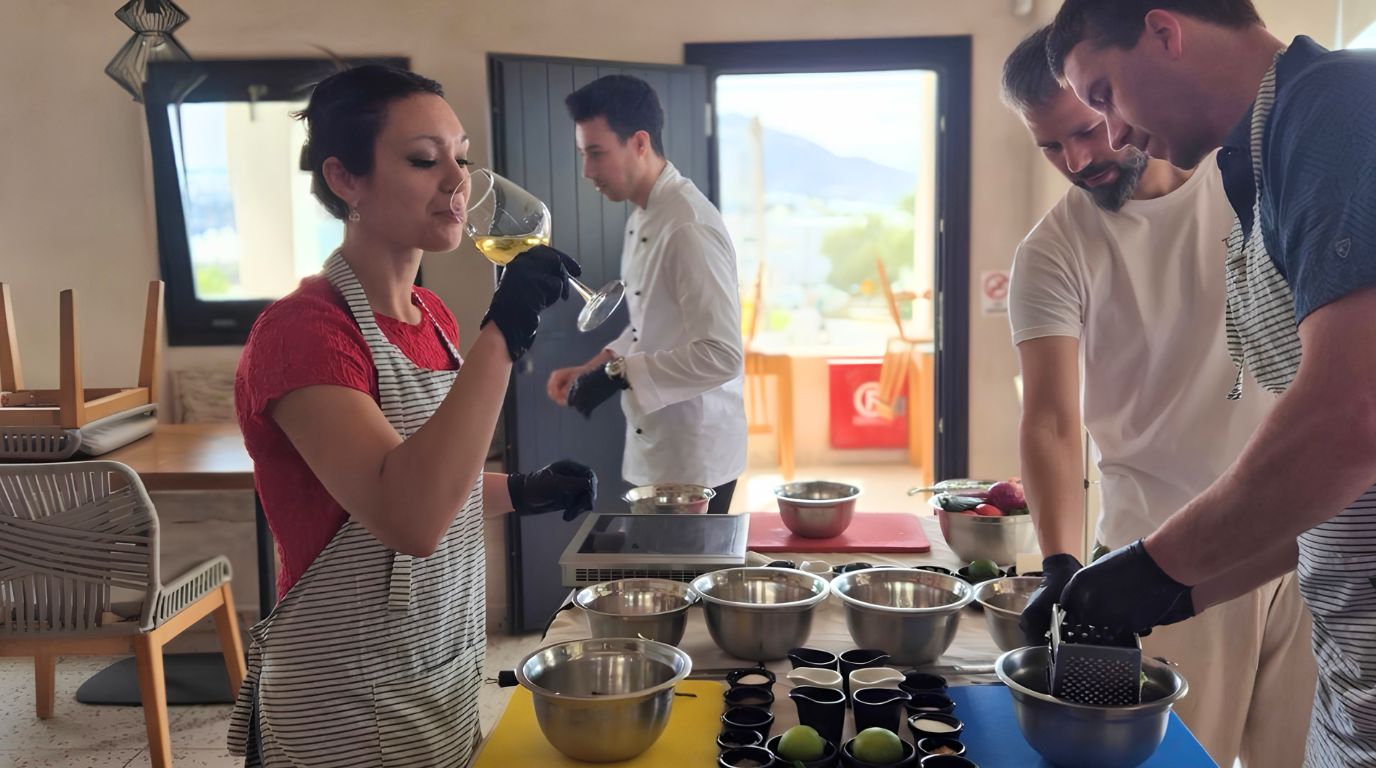
A 5-hour private class and wine tasting breaks down into a 30-minute pickup and transfer, 10 minutes on the ingredients, an hour and three quarters of hands-on cooking with wine poured alongside, an hour at the table eating your own dishes with a different wine beside each course, a transfer to a winery, a 45-minute guided tasting with a sommelier, and the return drop-off. The pacing is deliberately unhurried, which is the point of the private format.
| Time | What happens |
|---|---|
| 0:00 | Pickup from your hotel, the port, or the airport |
| 0:30 | Arrival at a traditional Santorinian kitchen, introductions, and about 10 minutes with the ingredients laid out and explained |
| 0:40 | Hands-on cooking, around 1 hour 45: tomato fritters, fava, island salad, pork tigania or chicken, ryzogalo. Wine is poured while you cook |
| 2:25 | You sit down and eat everything you made, about an hour, with a different wine beside each course |
| 3:25 | Transfer to a local winery |
| 3:55 | Guided 45-minute tasting with a certified sommelier, including Assyrtiko, Mavrotragano, and Vinsanto |
| 4:40 | Return drop-off |
The wine is not held back to the end, and that is the point. It is poured while you cook and then matched course by course at the table, so you meet each pairing against a dish you made twenty minutes earlier rather than hearing it described. The tasting that follows at a local winery builds on a palate that has already done the work.
The Short Version
A Santorini cooking class is worth your afternoon for one reason: the island’s food and its wine come from the same drought-stressed volcanic ground, and cooking with the ingredients is the fastest way to understand both.
Look for a class that puts your hands on every dish, uses genuine local produce rather than mainland substitutes, pours the wine next to the food instead of after it, and finishes at a working winery with someone who can explain the pairings.
Cook the fava, fry the fritters, then taste Assyrtiko beside them. Everything you eat for the rest of the trip reads differently afterwards.
Frequently Asked Questions
What is a Santorini cooking class?
A Santorini cooking class is a hands-on session, usually 3 to 5 hours, where a local chef teaches you to cook traditional island dishes using Santorini’s own produce. Most classes cover tomato fritters, fava, a local salad, a main such as pork tigania, and a dessert, then sit you down to eat what you prepared with the wines matched to each course, followed by a tasting at a winery.
How much does a cooking class in Santorini cost?
Group cooking classes in Santorini generally start around €150 per person. Private classes that include transport and a guided wine tasting at a winery start from €200. Price differences usually come down to group size, whether transport is included, and whether the wine tasting is led by a sommelier at a working winery.
How long does a Santorini cooking class last?
Most run between 3 and 5 hours. Around an hour and three quarters of that is hands-on cooking. The rest covers the meal itself, transport, and, in the better formats, a winery visit and guided tasting.
Is the wine served with the food or separately?
On the better classes it is served with the food. Wine is poured while you cook and then matched to each course at the table, so you taste every pairing against the dish itself rather than hearing it described afterwards. A separate guided tasting at a winery usually follows, which is where the wines get explained in depth.
Do I need cooking experience?
No. Santorini cooking classes are designed for complete beginners, and the chef guides every step. Confident cooks still get value from the local techniques and ingredients, which behave differently from mainland equivalents.
What food will I cook in a Santorini cooking class?
Typically tomato fritters (tomatokeftedes), Santorini fava, a fresh island salad with katsouni cucumber and capers, a main course, and a traditional dessert. On our class the main is pork tigania, with chicken for anyone who does not eat pork, served with the fava, and the dessert is ryzogalo, rice pudding with cinnamon.
What makes Santorini ingredients different?
Santorini receives less than 370mm of rain a year, and crops survive largely on dew absorbed by porous volcanic soil. Low water produces small, concentrated vegetables. Santorini cherry tomatoes weigh just 15 to 27 grams and carry high sugar and high acidity. Fava Santorinis, the island’s cherry tomato, and its white aubergine are all recognised local products, with the fava and the tomato holding PDO status.
Which wine goes with Santorini food?
Assyrtiko is the default pairing for most savoury Santorini dishes, because its high acidity and minerality cut through fried and oil-rich food. Nykteri suits denser dishes like fava, Aidani suits raw salads and fresh cheese, Mavrotragano handles pan-fried pork and chicken, and Vinsanto belongs with dessert.
Is a cooking class better than a food tour or a wine tour?
They serve different goals. A cooking class teaches you to make the food yourself. A food tour covers more venues and more variety. A wine tour goes far deeper on tasting, usually across two or three wineries. Only the cooking class sends you home with a repeatable skill.
Are vegetarian or allergy-friendly options available?
Yes. Vegetarian menus are standard on most Santorini cooking classes, and a chicken main is available in place of the pork. Allergies and dietary restrictions can be accommodated when you tell the operator in advance of the booking.
Is there an age limit?
The cooking portion suits all ages, but participants must be 18 or over to take part in the wine tasting.
Can cruise passengers do a cooking class in Santorini?
Yes, if the timing works. A 5-hour class fits comfortably into a full-day port call. Confirm your all-aboard time before booking, and check that cable car tickets are included, since the queue between the old port and Fira can be long in peak season.
How far in advance should I book?
Two to four weeks is safe in shoulder season. July and August book out earlier, so aim for four to six weeks in peak summer, particularly for private classes.
Ready to Cook It Yourself?
Book the 5-Hour Private Cooking Class and Wine Tasting
A local chef and a certified sommelier, a private group, hotel or port pickup, five dishes, wine through the cooking and the meal, and a four-wine tasting at a winery. From €200, fully refundable up to 3 days before.
Written by
Ioanna Pilati
Co-founder & Sales and Operations · Wineland Tours
Ioanna Pilati is the co-founder of Wineland Tours and a Santorini insider with firsthand knowledge of the island’s experiences, seasons, and hidden gems. Having lived and worked in Santorini, she has guided hundreds of travelers toward the right time to visit, the right wineries to explore, and the moments that make a trip truly memorable.